
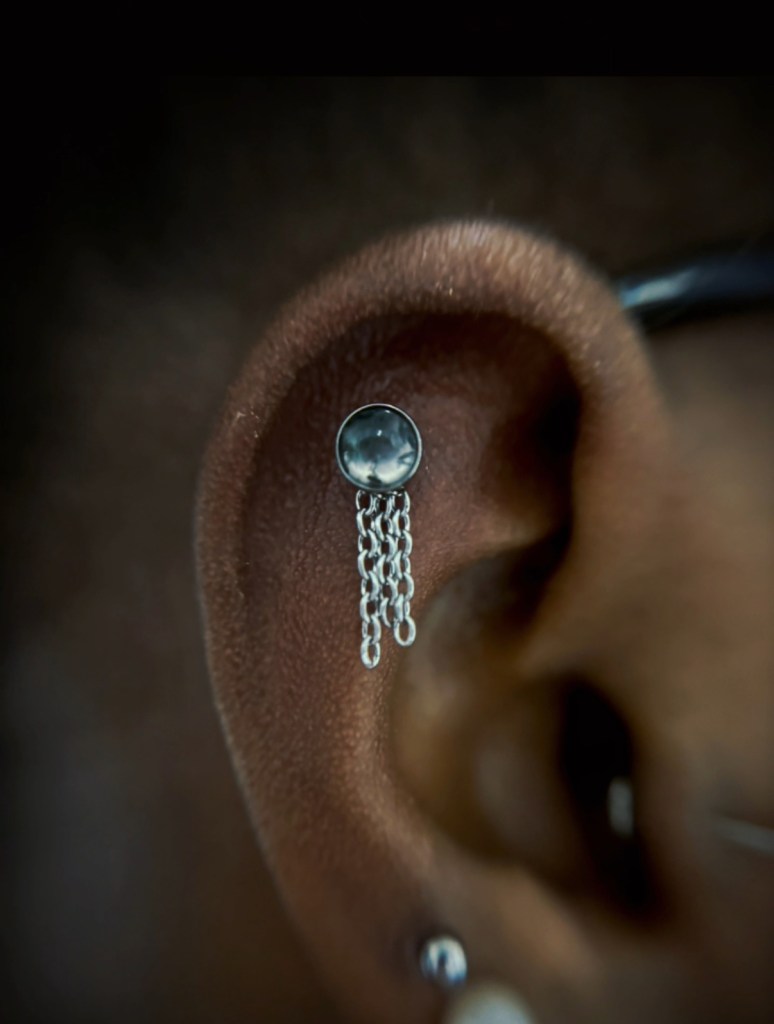
The Uncomfy Truth
You will heal at your own rate. Any healing time truly is an estimate.
Some people leave with their new piercing, and they come back for their downsize six weeks later, and six months later their new piercing is totally healed.
Other people have a bit of a bumpier ride. Maybe they get sick or get the flu, maybe they have a period of stress or a change of medication. Maybe that’s just how the cookie crumbles sometimes.
I dance around the question of, “How long is this going to take to heal?” , quite a lot, because the reality is that there is no straight forward, one-size-fits-all answer to the question. Lifestyle, to a certain degree your age, your skin type, life events, and good ol’ luck all have a part to play in how long it will take your piercing to heal.
Healing is four stages
Piercings are a wound, and your body doesn’t magically know the difference between a piercing and any other type of open cut. So, it heals it the same way.
The first stage of wound healing is hemostasis. This occurs literally moments after a wound is incurred – the blood clots, forming a flimsy barrier between your wound and the outside world, and stopping the bleeding.
The second stage of healing is inflammation. This is the stage during which a new wound (in this case, your piercing), is slightly swollen. This is caused by enzymes and cells flooding the site of the wound to assist healing. You’ll see scabs forming and some clear-to-pale-yellow coloured discharge, as your cells flush out “foreign” objects from the wound, and the remnants of cells that died repairing the wound. This is essentially the rapid-repair-kit of the body. The inflammation stage of healing lasts around six weeks, which is why we schedule your downsize appointments for this time period – the initial swelling period of healing is over, and now your piercing can accommodate smaller jewellery.
The third stage of wound healing is proliferation. This is the stage in which the body makes new granular tissue. This replicative tissue is normally slightly more pink/red than the uninjured skin around it, and on Black and Brown skin might appear ever so slightly purple. The tissue at this stage is beginning to create tissue that’s just like the uninjured skin was, but it’s still extremely fragile. If you’ve ever popped a blister and seen the fragile, baby skin underneath – that’s exactly what the tissue on the inside of your piercing looks like during this stage. The proliferation stage of healing can vary quite widely depending on the person and the piercing, but normally is happening for somewhere between six weeks to six months after a wound is incurred.
The fourth, and final, stage of wound healing is maturation. This can take up to two years to complete, sometimes even more. This is the stage in which the wound is becoming stable, the blood flow is returning, and collagen is allowing the wound to gain the same type of elasticity and resilience of unwounded skin. By the time your body is done with this stage, the scar tissue is only around 20% weaker than uninjured skin.
So…that’s a lot. There’s absolutely no way your body could accomplish all of this, and do the whole “keeping you alive” thing, in only six weeks! Unless of course, you’re secretly Wolverine or Count Dracula, in which case I’d probably be a bit scared to pierce you anyway.
So how long are we looking at?
Most earlobe piercings will take around three full months to heal, and the same goes for most oral piercing placements.
Helix, nostril and other cartilage piercings will take somewhere between six months to a year to “fully healed”. Eyebrow and nipple piercings also come in at around the six months mark.
Navel piercings come in the slowest, at up to eighteen months for some people.
Why do piercers say different things?
It can be lots of reasons.
One is what we define “healed” as. If you are considering a piercing no longer swollen or creating any crust to be “fully healed”, then the end of the inflammatory stage at six weeks might be counted as “healed”. But that’s playing a bit fast and loose with the definition of healed, in my opinion.
Piercers also have something to sell you. We’ll touch on jewellery for fully healed piercings in a moment, but there’s sometimes an element of them wanting a sale from you in there too.
Snug rings and other healed styles
“But I want a snug fitting nostril ring!”
You have to wait. I six months at a minimum, assuming you are healing well.
I get it, no one wants to wait. Your body does not provide Amazon-Prime-Next-Day-Delivery on healing.
The reason to wait is two-fold.
One is geometry. A ring is a circle, meaning the curve of the wearable area needs to be able to accommodate a fresh piercings healing – and this means the entire circle has to get bigger.
The second is what we touched about on stages of wound healing – once we achieve the maturation stage of wound healing, and the wounded skin is gaining elasticity and blood flow, it is still a bit weaker than never-injured skin. Putting in something that will move (and rings will always find a way to rotate) before a piercing is fully into the maturation stage of healing is a recipe for pretty extreme irritation, sometimes so severe that the only solution is removing it entirely.
Other than snug rings, there are other styles only suitable for healed, mature piercings. These include charms, dangles and other hanging elements like chains. This is to minimise a catch risk on skin too fragile to support that, and also to minimise excessive weight on a fresh wound. In addition, when piercings are still in the inflammatory stage and excreting discharge, chains and dangles are a perfect place for rough crust to rapidly build up, becoming difficult to clean and a further source of potential irritation.
How do I heal faster?
You can’t, really.
There’s no product on the planet that you can buy to magically heal a wound faster. Think about – if there was, we’d be using it in hospitals all over the world and we’d be able to get it on prescription!
You can give yourself the best shot at healing well by simply being healthy. Stay hydrated, eat a good diet, and get plenty of good sleep to allow your body to rest. Performing your aftercare correctly will also enable to best possible healing journey. These are about the only parts of wound healing that are under your control.
Do you have questions about a piercing you’re healing? Whether I pierced you or not, I am always happy to help you. Reach out on Instagram to @doingtheunstuck and I will do my best to be of assistance!
 Doing The Unstuck
Leave a comment